
We Built Things to Do

I know I am in trouble when I quit wanting to make things.
Not for clients. Not for money. Not because they needed doing.
Just because.
For most of my life, creating things has been a reasonably accurate gauge of my emotional health. When life is good, or at least manageable, I draw. I build things from wood. I write. When life gets heavy, those things tend to disappear.
Lately, I’ve been distracted by the ordinary responsibilities of adulthood. The kind that arrive whether you’re ready for them or not. Running a business. Paying bills. Maintaining a home. Planning for retirement. Trying to make sure the wheels stay attached to the wagon for one more day.
It’s not that I don’t do things anymore. It’s that most of the things I do now are designed to keep other things from falling apart.
I work to avoid being broke. I maintain my house to avoid expensive repairs. I exercise to avoid becoming a patient instead of a customer. I save money to avoid problems that haven’t happened yet.
The effort is still there. The purpose has changed.
As a kid, I spent an astonishing amount of energy creating things that served no practical purpose whatsoever. Forts nobody lived in. Bicycle ramps nobody asked for. Holes that accomplished nothing. Entire afternoons devoted to projects that made perfect sense at the time and no sense whatsoever in hindsight.
Nobody was paying me. Nobody was grading me. Nobody was expecting results.
The project itself was the reward.
When I was a kid, effort was usually directed toward making something happen. Sometimes that something was impressive. Sometimes it was spectacularly stupid. Usually it was both.
We built forts in the woods because there weren’t any forts there yesterday. We dug holes simply because we wondered how deep a hole could be. A surprising amount of Southern childhood involved digging. Holes. Tunnels. Fort foundations. We moved enough Georgia clay with garden shovels to qualify as a public works department.
We built bicycle ramps inspired by Evel Knievel and supported by little more than optimism and scrap lumber. We launched ourselves off homemade ramps, over drainage ditches, and occasionally over each other. Most of us learned the difference between courage and stupidity one skinned elbow at a time.
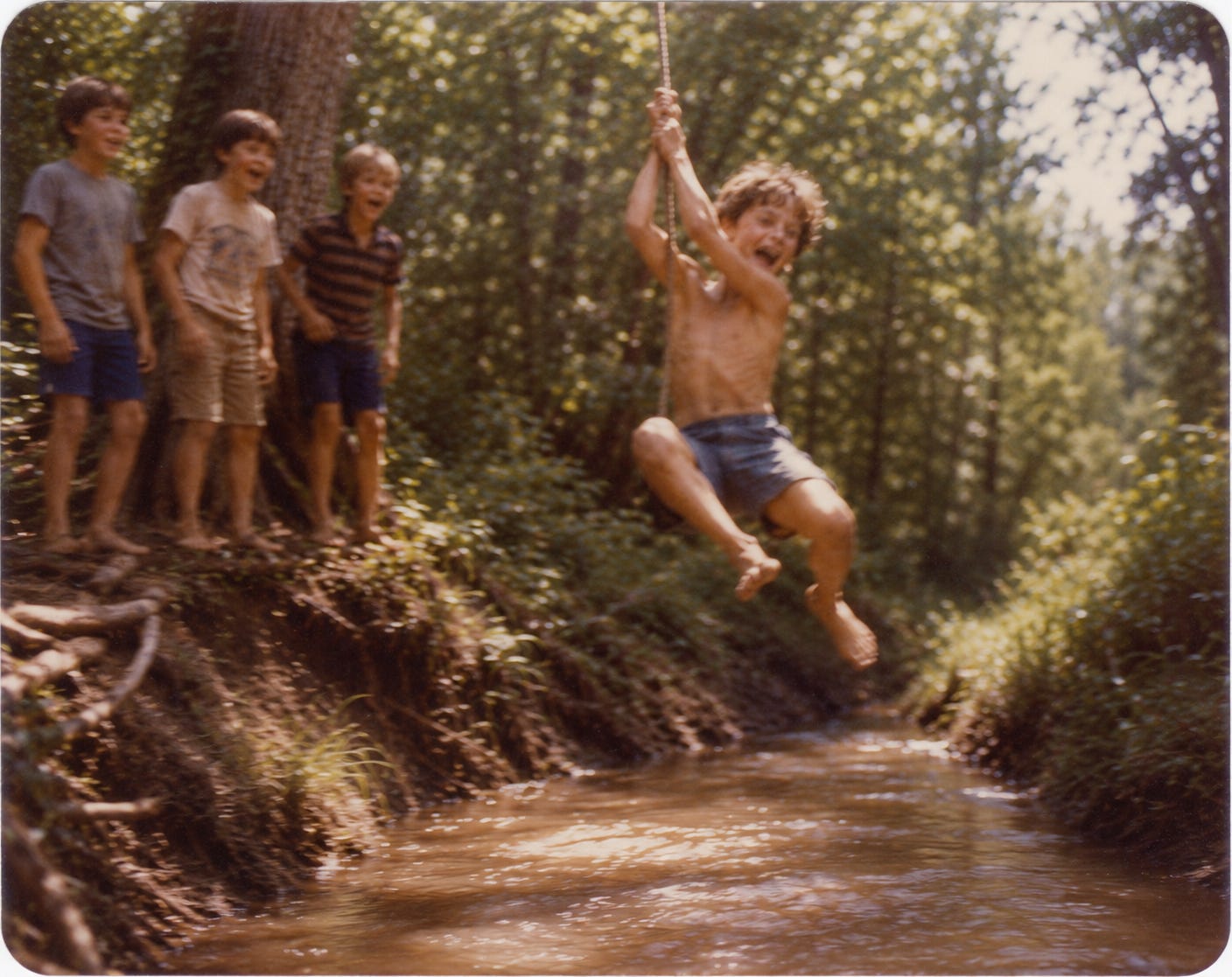
We caught snakes. Climbed trees. Started campfires. Explored creeks. Swung from vines.
One summer, my friends and I dug caves into the clay cliffs overlooking the railroad tracks near our neighborhood. We never once considered the possibility that several tons of dirt might collapse on top of us.
Looking back, that may explain a few things.
What I find interesting is that boredom was responsible for most of it.
People talk about necessity being the mother of invention. I suspect boredom deserves some credit. Boredom built forts. Boredom created bike ramps. Boredom inspired caves, treehouses, rope swings, and countless inventions that seemed brilliant right up until the moment they weren’t.
Boredom led to creativity. It also led to emergency room visits.
The same force produced both outcomes.
Today, boredom barely gets a chance to stretch its legs. The moment we find ourselves sitting in a waiting room, standing in line, or enduring a commercial break, we reach for our phones. Sports scores. News. Social media. Emails. Weather forecasts. News about people we’ll never meet in places we’ll never visit discussing problems we’ll never personally encounter.
Every empty moment gets filled before our minds have a chance to wander.
Maybe that’s why writing has felt harder lately.
The funny thing is that we claimed to love sports. And we did. We just didn’t love them enough to sit still all day.
The Braves were usually on in the background. So were the Falcons when they weren’t finding new and inventive ways to break our hearts. We’d watch an inning or two, maybe a quarter of a football game, then disappear the moment somebody showed up on a bicycle and suggested doing something that sounded fun, dangerous, or both.
The game wasn’t the event.
The game was what happened while we were waiting for the event.
Today, I can sit on the couch watching a game while simultaneously checking scores from three other games, scrolling through headlines, answering emails, and wondering why I feel mentally exhausted. I have more information than I’ve ever had.
I’m not convinced I’m having more experiences.
As kids, we knew very little about the wider world. We couldn’t tell you what was happening in Washington, New York, Los Angeles, or overseas. We barely knew what was happening on the other side of the county.
Yet somehow we always seemed to know exactly where our friends were.
If there was a bicycle lying in a front yard, a pickup parked beside a creek, or a cluster of boys gathered near a patch of woods, that was all the information we needed.
Maybe that’s what I miss most about those years.
Not the bikes. Not the forts. Not even the freedom.
I miss the luxury of effort without obligation.
Back then, we spent our energy creating things. Today, we spend much of our energy maintaining things. One builds stories. The other prevents disasters.
Both are necessary.
Only one leaves you with a rope swing hanging over a busy road, a half-finished fort in the woods, and memories that somehow survive for forty years.
Today, sitting still is a rare luxury. As boys, sitting still felt like punishment. As men, it feels like freedom.
Maybe that’s because there was a time in life when most of our effort went toward making things happen. Now most of our effort goes toward keeping things from falling apart.
Come to think of it, maybe writing belongs in that category, too.
Maybe that’s why I keep coming back to it.
Because unlike repairing a roof, balancing a budget, or answering emails, a column doesn’t exist because it has to.
It exists because it didn’t yesterday.
And sometimes that’s reason enough.